
Why Boutique Hotels Work for Corporate Retreat Venues

The corporate conference room has a credibility problem. Most people who have spent time in one know that the combination of strip lighting, a generic buffet, and a screen that takes fifteen minutes to connect to rarely produces the quality of thinking it was designed to enable. The environment communicates something, and what it communicates is that the time together is functional rather than valued.
Boutique hotels offer a different proposition. A well-chosen, characterful setting with genuine hospitality, serious food and wine, and spaces designed to be lived in rather than occupied creates a different quality of conversation. The thinking sharpens. The dynamic shifts. The retreat becomes the occasion it was intended to be.
Hotel du Vin is a collection of individually designed, dining-led properties across the UK, and it suits corporate retreats and leadership offsites particularly well. The following covers the case for stepping away from the office, why intimate venues consistently outperform large conference hotels for focused group work, what Hotel du Vin specifically offers, and how to structure and plan a retreat that earns its place in the diary.
What is a corporate retreat, and why do they work?
Before exploring the venue question, it is worth being clear about what a corporate retreat actually is and why the evidence for its value is stronger than the hesitation around organising one tends to suggest.
Defining the corporate retreat
A corporate retreat is a structured offsite for a leadership team or business unit to focus, plan, and reconnect outside the usual office environment. In practical terms, it is a defined period, typically one to three days, during which the group steps away from operational pressures to do the kind of thinking that the day-to-day rarely makes room for.
The distinction from a standard away day is meaningful. An away day tends to be shorter, more activity-led, and less deliberately agenda-driven. A retreat carries a stronger emphasis on strategic thinking, team cohesion, and outcomes that persist beyond the event itself. The duration matters: staying overnight changes the quality of the time together in ways that a single day rarely achieves.
The case for stepping away
The research on offsites is consistent. Removing a team from their usual surroundings improves decision-making quality, increases creative output, and strengthens cross-team communication. The operational noise that fills a normal working week, the emails, the interruptions, the pull of immediate tasks, is absent. People think differently when they are not in the place where they usually think about other things.
The setting reinforces this. A generic conference centre signals a generic outcome; a thoughtfully chosen venue signals that the time together has been valued and invested in. That signal shapes how people engage with the agenda before the first session has started.
The planning hesitations are understandable: cost, logistics, justifying time away. The more useful framing is the cost of not doing it. Teams that do not create structured time for strategic thinking tend to spend more time reacting and less time choosing. The missed opportunity is rarely visible, which is partly why it is so easy to defer.
Why smaller, boutique venues suit leadership retreats
With the case for retreats established, the venue question becomes the most consequential planning decision. Smaller, characterful properties consistently outperform large conference hotels for focused group work, and the reasons are worth understanding.
Intimacy and atmosphere
Large conference hotels are built for volume. The spaces, the service model, and the operational logic are all oriented towards processing a high number of events simultaneously. For a leadership team of eight to twenty people wanting focused, high-quality time together, that model works against the objective. The energy is diffuse, the service is divided, and the sense of occasion is absent.
Intimate properties work differently. Fewer distractions, more personalised service, and a stronger sense that the venue is genuinely oriented towards the group rather than managing it alongside twenty other events. The atmosphere of a well-designed boutique hotel, the proportions of the rooms, the quality of the materials, the care in the details, shapes group dynamics in ways that are difficult to articulate but consistently reported by those who have experienced both.
The role of dining in a successful retreat
A shared meal at a well-regarded restaurant creates a different quality of conversation than a buffet lunch in a windowless breakout room. This is not a trivial point. Some of the most valuable moments in a corporate retreat happen in the informal space around the table, where the agenda is off and the conversation is more honest. The quality of the food and the setting directly influences whether that space opens up or closes down.
Boutique hotels where dining is taken seriously, rather than treated as a logistical necessity, integrate this into the retreat experience naturally. Hotel du Vin's approach to dining and its dinner, bed, and breakfast experience both reflect a philosophy in which the hospitality is part of the offer rather than an addition to it.
Flexibility is also a practical advantage of smaller venues. More adaptable room configurations, direct communication with a single events team rather than a tiered corporate structure, and a willingness to shape the experience around the group rather than fitting the group into a standard package are all characteristics that boutique properties tend to offer more readily than large conference hotels.
What Hotel du Vin offers for corporate retreats
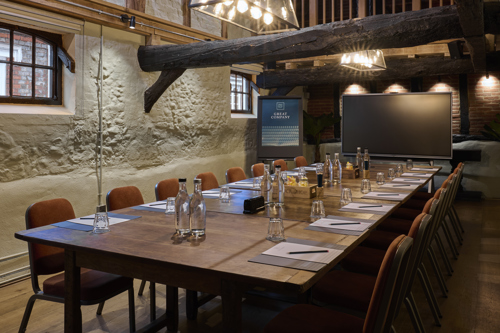
Hotel du Vin's meetings and events offer is built around the same principles that define the wider brand: character, quality, and a hospitality-led approach that treats the experience as the product rather than a backdrop to it.
Meetings and event spaces
Hotel du Vin properties offer private dining rooms, flexible meeting spaces, and dedicated event support across multiple UK locations. The corporate retreat offering is tailored to smaller, more focused groups rather than large-scale conference logistics, which makes it well suited to leadership teams and senior offsites where the quality of the environment matters as much as the practicalities.
The variety of locations across the UK is a genuine asset. Groups can choose a setting that is relevant to their team, whether that is a city centre property, a riverside location, or a historic market town, without being forced into a one-size-fits-all product. The rooms themselves are individually designed and characterful, which means overnight stays are part of the experience rather than a functional necessity.
Food, wine, and private dining
The food and wine focus is where Hotel du Vin differentiates most clearly from standard corporate venues. Bistro du Vin dining, curated wine lists, and the option to build hospitality deliberately into the retreat agenda give the experience a quality that generic conference catering cannot match. The private dining offer allows groups to use a dedicated space for a working lunch or a celebratory dinner, while the broader food and drink offer gives the retreat a texture across the whole stay rather than just the formal sessions.
The mix of spaces across a stay is part of what makes it work. Meeting in a private room in the morning, dining together in the bistro in the evening, and carrying the conversation into the bar afterwards creates a rhythm that a single-room conference day cannot replicate.
Corporate retreat ideas: how to structure a Hotel du Vin offsite
The venue sets the conditions for a good retreat. The structure determines whether those conditions are used well.
A suggested retreat framework
A one-night retreat at Hotel du Vin might run as follows. Arrival and check-in in the early afternoon, followed by an opening session of one to two hours focused on context-setting or a specific strategic question. A break, then a second working session in the late afternoon. Group dinner in the bistro or a private dining room, with the agenda set aside and the conversation allowed to run where it goes. The following morning: a shorter, sharper wrap-up session focused on decisions, commitments, and next steps, followed by checkout.
A two-night format allows more depth: a full working day between two evenings, with space for a longer strategic session, individual reflection time, and a more extended informal period on the second evening. Different objectives suit different structures. Strategic planning benefits from longer working blocks. Team reset retreats benefit from a higher proportion of informal time. Leadership development or creative brainstorming sessions often work best with external facilitation built into the agenda.
Who is Hotel du Vin best suited to?
The venue works with event organisers to tailor the experience from the outset: AV setup, bespoke menus, wine pairings selected to suit the occasion, and room configurations adapted to the group's working style. The quality of unscheduled time matters as much as the structured sessions, and Hotel du Vin's hospitality culture creates the conditions for that time to be genuinely productive rather than passively social.
In terms of group type, Hotel du Vin suits senior leadership teams, board offsites, small agency or professional services teams, and founders and advisors who want a setting that reflects the seriousness of the time together without the formality of a traditional conference venue. The sweet spot is groups of roughly six to twenty-five people who want focused work, excellent food, and an environment that makes the whole experience feel considered.
Choosing the right Hotel du Vin location for your retreat
With properties across the UK, the location decision is worth approaching with the group's needs in mind rather than defaulting to the nearest option.
A selection of standout locations
Brighton suits groups wanting a coastal setting with creative energy and strong rail connections from London. Cambridge offers historic surroundings and a quietly intellectual atmosphere that lends itself well to focused strategic thinking. Henley-on-Thames provides a riverside setting with an immediate sense of remove from the usual working environment, particularly well placed for London-based teams.
Cannizaro House, set within Wimbledon Common, brings country house character without the logistics of travelling far from the city. Tunbridge Wells combines elegant surroundings with easy access from London and the South East. Winchester offers a historic market town setting with good connections and a calm atmosphere well suited to leadership offsites.
Ease of access is a practical factor worth weighing. Most Hotel du Vin properties are well connected by rail, which simplifies logistics for teams travelling from different locations and removes the coordination overhead of car-sharing or parking arrangements.
All available locations are listed on the corporate retreat page, where you can explore spaces, capacity, and get in touch with the events team.
Getting in touch
The events team works with groups to tailor the experience to their specific objectives, group size, and budget, covering accommodation, dining, and meeting room arrangements in a single conversation rather than across multiple departments. The most useful first step is a direct enquiry with as much context as possible: group size, preferred dates, the broad objectives for the retreat, and any specific requirements around format or catering.
Explore Hotel du Vin's meetings and events offer, check current offers, or contact the team to discuss your next corporate retreat. A well-chosen boutique venue changes the nature of the conversation, and Hotel du Vin offers a genuinely distinctive setting for that across multiple UK locations.
Corporate Retreat FAQs
What is a corporate retreat?
A corporate retreat is a structured offsite event that takes a leadership team or group of colleagues away from the usual work environment for a defined period, typically one to three days. Retreats focus on strategic planning, team development, or creative thinking, and work best when the venue is chosen to support the objectives of the time together.
What are the benefits of a corporate retreat?
Corporate retreats create space for the kind of focused, high-quality thinking that is difficult to achieve in a busy office environment. They support better decision-making, stronger team relationships, and clearer strategic alignment. Research consistently shows that removing a team from their usual surroundings improves creativity and the quality of collaborative work.
Why choose a boutique hotel for a corporate retreat?
Boutique hotels offer a more personalised, characterful experience than large conference venues. Smaller group sizes are better accommodated, service tends to be more attentive, and the environment itself contributes to a sense of occasion. A well-chosen boutique hotel signals that the time together has been invested in, which shapes how a team engages with the agenda.
Does Hotel du Vin have meeting rooms and event spaces?
Yes. Hotel du Vin properties offer a range of meeting rooms and private dining spaces suitable for corporate retreats, leadership offsites, and working sessions. Most locations can accommodate small to medium-sized groups, with support from an events team, AV equipment, and bespoke catering options. Visit the meetings page or contact the team directly to discuss your requirements.
How do I book a corporate retreat at Hotel du Vin?
You can enquire about corporate retreat packages directly through the Hotel du Vin website. The events team works with groups to tailor the experience to their objectives, group size, and budget, including accommodation, dining, and meeting room arrangements. Visit hotelduvin.com/meetings or contact the team to get started.