
St Andrews Beyond the Golf Course

Say the name St Andrews and golf gets there first: the Old Course, the R&A, clubs already half-packed in the boot before the trip is even confirmed. For most visitors, the town and the game are close to the same thing, and it is easy to see why, given how much of the world's golfing history runs through these few streets.
Strip the fairways away, though, and St Andrews is still one of the oldest and most complete small towns in Scotland, built around a cathedral, a university and a stretch of coastline that owes nothing to a scorecard. The ruins here predate the game by centuries, the university has its own traditions, and the coast offers plenty to explore without a scorecard in sight.
This is a look at the town beyond that: the ruins older than the game itself, a university town with its own traditions, the coast beyond the fairways, food and drink worth staying in for, and where to base it all.
Historic Ruins Older Than the Golf Course
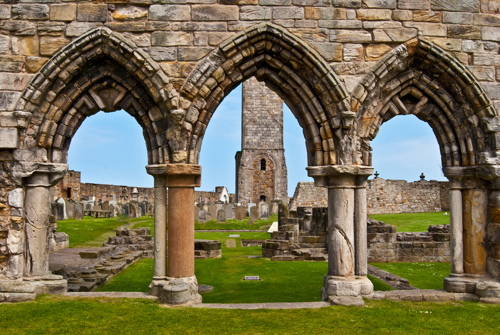
St Andrews Cathedral was once the largest church built in Scotland, and what remains still carries that scale: the east and west gables, long stretches of the nave and transept walls, and the Pends, the twin archways that once formed the priory's gatehouse.
Climb St Rule's Tower, older than the cathedral itself, and a spiral stair (added in the 18th century in place of the original wooden ladders) leads up to a view that takes in the town's rooftops, the harbour, and the coastline stretching away on both sides, worth the climb on a clear day in particular.
A short walk from the cathedral, St Andrews Castle sits on its own stretch of clifftop, wind off the North Sea reaching the ruins in a way it never quite does further inland. The castle served over roughly 450 years as a bishop's palace, a fortress and a state prison.
The bottle dungeon beneath it counts among the more infamous cells in medieval Britain, and the mine and countermine dug into the rock during the 1546 to 1547 siege, tunnels driven by attackers and defenders both trying to reach the other first, can still be explored today.
A University Town With Its Own Traditions
The University of St Andrews has been teaching since around 1410 and was formally established by papal bull in 1413, making it one of the oldest universities in the English-speaking world, older than several countries currently on the map.
Its cobbled streets and quads are open to walk through without needing a student ID, part of the town rather than fenced off from it, the line between university and everyday St Andrews blurring more here than it does in most university towns.
Time a visit for a Sunday during term and there is a genuine tradition to see: the Pier Walk, students in red undergraduate gowns processing from St Salvator's Chapel along The Scores to the harbour pier and back. It traces to January 1800, when a student named John Honey swam repeatedly out to the wrecked Janet of Macduff to bring its crew ashore, an act of courage the university has marked ever since.
Explore the Coast Beyond the Fairways
West Sands stretches for almost two miles along the edge of the town, dunes on one side and the water on the other, familiar to anyone who has seen the opening of Chariots of Fire without necessarily placing it.
The walk holds up whether or not the course running alongside it means anything at all, the beach doing its own work regardless of the sport next to it. From St Andrews, the Fife Coastal Path continues south towards the fishing villages of Crail and Anstruther, a route that stretches easily into a half-day for anyone who wants more than an hour on the sand, harbours and painted cottages replacing dunes the further along it goes.
Food and Drink Worth Staying For
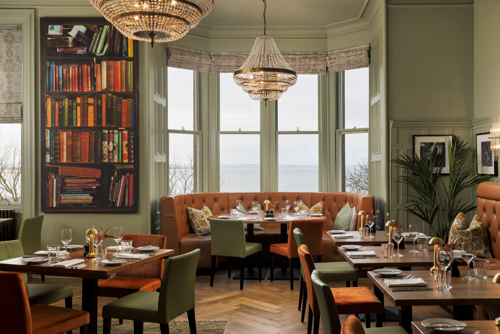
St Andrews carries a food scene more developed than most towns its size manage.
The Adamson, set in a former post office building with its Victorian proportions largely intact, is a strong dinner option beyond the hotel, the kind of room that makes a Tuesday night booking feel like an occasion without trying too hard to be one.
Jannettas Gelateria has been serving the town for more than a century and remains a fixture rather than a novelty, and Cromars has been named among Scotland's best more than once for fish and chips that draw a queue even on a cold evening.
Bistro du Vin St Andrews anchors an evening between all of it: French classics alongside British favourites, and a bar built around a proper wine cellar with a Scottish whisky selection that holds its own alongside it.
If Golf Is Still Part of the Trip
For visitors who do want to play, golf can still form part of the trip without defining the whole stay.
Planning ahead helps, particularly when it comes to tee times, the daily ballot and choosing between the Old Course and the other golf courses in St Andrews.
Which course works best will depend on experience, availability and how much time you want to spend on the fairways alongside everything else the town has to offer.
Staying at Hotel du Vin St Andrews
Hotel du Vin St Andrews sits on The Scores, close enough to the cathedral, the castle and West Sands that none of them need a taxi, with 42 individually designed rooms and suites above a bistro and bar built on seasonal, locally inspired dishes with a classical French influence, a curated wine list and that same strong Scottish whisky selection.
It is a location suited to the whole town, not only to guests here for a round nearby, and a quieter base than most of the golf-focused hotels clustered closer to the Old Course itself.
Getting there is straightforward either way. Leuchars, the nearest train station, sits on the main line between Edinburgh and Dundee, around six miles out and roughly 15 minutes into town by bus or taxi. By road, St Andrews is about 50 miles from Edinburgh via the M90 and A91, typically an hour to an hour and a half depending on traffic, with Edinburgh Airport the nearest international gateway.
A stay here also means starting the next morning without much of a plan required, breakfast at Bistro du Vin before whichever of the cathedral, the coast or the university's quiet streets suits the day ahead. Book a stay at Hotel du Vin St Andrews and give the parts of the town the Old Course never mentions the time they deserve.
Check current room and dining offers before settling on dates.
FAQs About Things to Do in St Andrews
Can St Andrews be a day trip from Edinburgh?
Yes, though a day trip means working around the last train back to Edinburgh, which tends to be the limiting factor rather than the journey there. Staying overnight avoids that clock entirely and leaves room for a coastal walk or a proper dinner rather than watching the time.
Why is St Andrews so iconic?
St Andrews' reputation was built well before golf entered the picture: the town was once Scotland's ecclesiastical capital, home to the country's most powerful medieval cathedral, and its university predates the game's recorded history there by centuries. Golf's own status grew over generations, with St Andrews already being described as a "metropolis of golfing" as far back as 1691, long before the R&A grew into the rule-making authority the game recognises today.
What is the best time to visit St Andrews?
Spring through early autumn brings the most reliable weather for West Sands and the coastal path, and lines up with the University of St Andrews's term-time traditions like the Pier Walk, which doesn't run during the summer break. A winter visit trades some of that activity for a quieter town and cathedral ruins with the crowds thinned out, without losing what makes St Andrews worth visiting beyond the golf season.
How to spend a day in St Andrews?
There is more here than a single day in St Andrews comfortably allows, so the honest approach is to pick a focus rather than rush all of it: the cathedral and castle for history, West Sands and the coastal path for the outdoors, or the food scene for an unhurried evening. Two nights removes the trade-off and allows time for more than one of those.
Is Hotel du Vin St Andrews a good choice for visitors who don't golf?
Yes, and arguably more so: much of St Andrews' accommodation leans towards golf resorts built around the courses, while Hotel du Vin sits in the historic town centre itself, positioned for the cathedral, the coast and the food scene rather than a tee time. It is a genuinely different kind of stay from the golf-focused options nearby.